
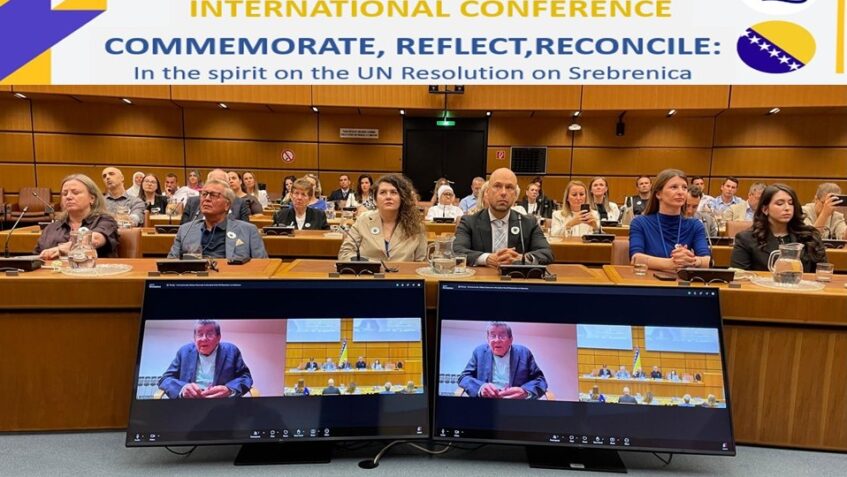
U petak, 03. jula 2025. godine, u prostorijama Ujedinjenih Nacija u Beču (Vienna International Centre), održana je međunarodna konferencija pod nazivom “Komemoracija, Refleksija, Pomirenje: U duhu Rezolucije UN-a o Srebrenici” “Komemoracija, Refleksija, Pomirenje: U duhu Rezolucije UN-a o Srebrenici” statt.
Konferenciju je organizovalo Bosansko Akademsko Društvo u Austriji uz podršku misije BiH u Beču.
Skupu su uz Bosance koji žive u Austriji, prisustvovali ambasadori i delegacije iz više zemalja, što ovom događaju daje snažan međunarodni značaj i potvrđuje važnost globalne solidarnosti u borbi protiv poricanja i zaborava genocida, ali i potrebi o traženju puteva pomirenja.
Učesnici konferencije bili su:
Siradj Duhan, predsjednik Bosanskog Akademskog Društva u Austriji
„A Call to Reconciliation and Renewal“
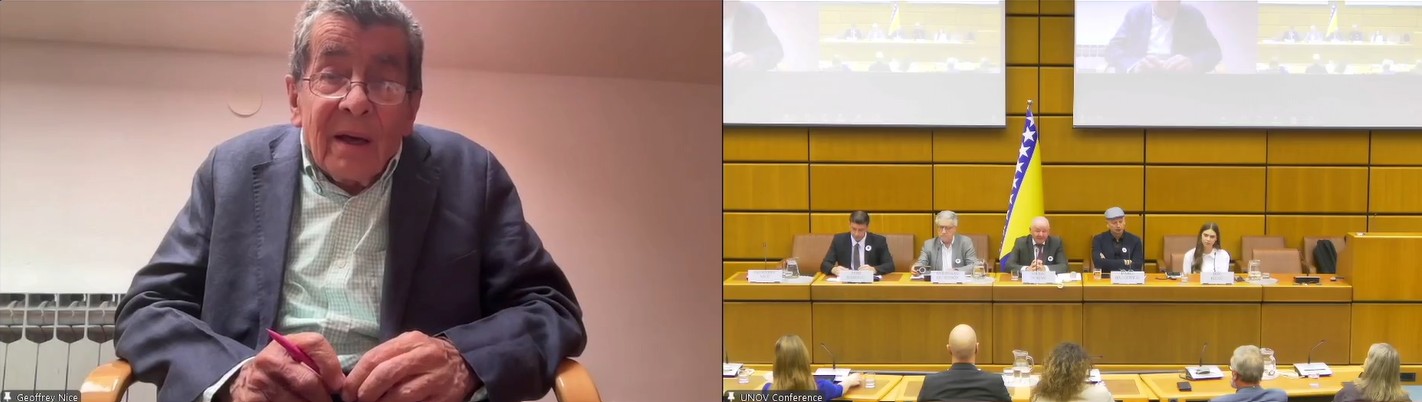
Geoffrey Nice, Bivši tužilac pri međunarodnom krivičnom sudu za bivšu Jugoslaviju
„Has the international community drawn any lessons from Srebrenica?“
Hariz Halilovich, Srebreničanin, Profesor antropologije na RMIT University u Melburnu
„Srebrenica, 30 Years On: Remembrance, Trauma, and the Diaspora“
Wolfgang Petritsch, Bivši visoki predstavnik za Bosnu i Hercegovinu
„Srebrenica and Europe“
Asim Dorović, Ministar-savjetnik misije Bosne i Hercegovine pri OSCE i UN u Beču
„Reflections on 30 Years Since Srebrenica“
U programu je prikazan i kratki video pod nazivom „Srebrenica: 30 godina poslije“, koji je kroz emotivne slike podsjetio na razmjere tragedije i važnost kolektivnog sjećanja.
Skup je moderirala članica Bosanskog Akademskog Društva u Austriji, Iris Begić.
Iz govora Hariza Halilovicha:
For me, speaking about Srebrenica is never simply an academic exercise. I was born there, and like thousands of others from my hometown, my life has been permanently shaped by what happened in July 1995. While I survived because I was outside the enclave when the genocide occurred, members of my extended family, neighbours and childhood friends did not. My birthplace became a place of death—a landscape of mass graves, absence and unfinished mourning.
That experience has also shaped my work as a scholar. Over the past two-and-a-half decades I have tried to understand not only what genocide destroys, but also what comes afterwards: how people rebuild lives after mass violence; how memory becomes woven into everyday life; and how survivors continue living when the past remains politically contested. Anthropology, my own discipline, is particularly well placed to ask these questions because it is concerned not only with moments of extraordinary violence, but also with the ordinary lives that follow.
Thirty-one years after the genocide, Srebrenica occupies a deeply paradoxical place. It has become one of the world’s most recognised symbols of genocide since the Holocaust. The crimes have been established through extensive scholarship, forensic investigation and international court judgments. Yet at the same time they continue to be denied, relativised and politically manipulated. For many survivors, then, genocide has never become simply history. It remains an ongoing social reality.
This is why I suggest we think of genocide not only as an event, but as a social process whose consequences continue to unfold long after the killing stops.
……………………………..
Iz govora Siradja Duhana:
History teaches us that reconciliation is possible. Yet, thirty-one years after the genocide in Srebrenica—a crime unequivocally established by the International Court of Justice and the ICTY—we must ask: why do the Western Balkans continue to struggle to transform a painful past into a shared future?
Consider the rivers that run through our region. The Drina, the Sava, the Danube—they do not recognize borders, nor do they ask for passports. They flow through Bosnia and Herzegovina, Serbia, and Croatia, indifferent to our human divisions. Their value depends entirely on whether communities on both banks choose to protect them together.
I submit that reconciliation is this river. It does not erase the tragedy upstream, but it offers a current toward a common delta.
Let us be clear: historical truth, as established by international courts, cannot be subject to political reinterpretation. Accountability must remain individual, never collective. A child born today in Belgrade bears no guilt for the crimes of the past. But that child does have the right to grow up in a society that honors truth over myth.
Srebrenica must remain a place of remembrance and sorrow. But let it also become a crossing point—not a dead end. Let it be the place where we prove that the river of history, however turbulent its course, can still flow toward a shared sea of civic dignity and lasting peace.
The question, distinguished guests, is whether leaders in Belgrade, Zagreb, Sarajevo, and beyond have the courage to step into that river together. We need a Willy Brandt from Belgrade.
Utisci sa konferencija:

No Comments